Write your first lecture note
Write a short lecture note with sections, formulae, a theorem and its proof, a captioned figure and a cited source, and save it as a private draft.
In about ten minutes you will write a one-page lecture note on the mean value theorem: two sections, formulae in the text and on lines of their own, the theorem with its proof, a figure with a caption, and a source the reader can follow. It is saved as a draft, which only you can see, so nothing here becomes public until you decide it should.
You need an account, and an image to use as the figure: a PNG, JPG or SVG of a graph will do.
Start a draft
- Go to
/new, which New publication on your home page opens, and choose Write. - Choose English as the language and Lecture as the type, then Start writing. The language decides how labels are printed: in an English note a theorem is labelled Theorem, in a Russian one Теорема.
- In Title, type
The mean value theorem. The title is the page's heading, so the text below does not repeat it. - Click the body to open the editor, and choose Code at the top. Code shows the Markdown exactly as you type it. Visual shows the same text formatted, and you can switch between the two at any time.
The draft is saved as you work.
Write the sections
-
Type two section headings, each a line starting with
##and a space:## Statement ## Why it matters
Sections start at ## because the title already holds the top level. Each
heading becomes an entry in the page's contents, and a link to it can be
shared.
State the theorem
-
Under Statement, open a theorem block with a line
:::theorem[Mean value theorem], write the statement, and close the block with a line:::::::theorem[Mean value theorem] Let $f$ be continuous on $[a, b]$ and differentiable on $(a, b)$. Then there is a point $c \in (a, b)$ with $$ f'(c) = \frac{f(b) - f(a)}{b - a}. $$ :::
The words in brackets are the theorem's name, printed after its label. The statement is set in italics, as in a printed text.
The formulae are LaTeX. A formula inside a sentence goes between single
dollar signs, $f$. A formula on its own line goes between $$ lines, and
the two $$ must stand on lines of their own: written as $$…$$ within one
line, it stays in the line.
Prove it
-
Directly under the theorem, add a proof block:
:::proof
The function $g(x) = f(x) - \frac{f(b) - f(a)}{b - a}(x - a)$ has
$g(a) = g(b) = f(a)$, so by Rolle's theorem $g'(c) = 0$ for some
$c \in (a, b)$, which is the claim.
:::
The page labels it Proof. and ends it with ∎, so do not type a QED mark yourself.
Add a figure
-
Under Why it matters, write the sentence that points at the figure:
The secant through the ends of the graph has a parallel tangent, as [the figure](#fig-mean-value) shows. -
Switch to Visual, put the cursor on an empty line below that sentence, and choose Media. Under Upload, drop your image, describe it in Alt text (what the image shows, for a reader who cannot see it), and choose Upload & insert.
-
Switch back to Code. The image is now a line of the form
. Put a line::::figure{#fig-mean-value}above it, a caption under it, and a line::::under the caption:::::figure{#fig-mean-value}  The tangent at $c$ is parallel to the secant through $(a, f(a))$ and $(b, f(b))$. ::::
The first block inside a figure is its content and everything after it is the
caption. The figure fence has four colons rather than three because a figure
can hold another block. {#fig-mean-value} is the figure's anchor: the link
in your sentence jumps to it.
Cite a source
-
At the end of the theorem's opening sentence, or wherever you rely on the source, add a footnote marker,
[^rudin]. -
Anywhere below, on a line of its own, write the note:
[^rudin]: W. Rudin, *Principles of Mathematical Analysis*, 3rd ed., McGraw-Hill, 1976, Theorem 5.10. -
Close the editor, open the References tab, and choose Add Reference. Under Add new, fill in the title, the author and the year, and choose Save.
The footnote is numbered on the page and gathered at the bottom with a link
back. The reference is listed under the note, where a reader can copy it as
BibTeX or save it to their own library. The [@key] citation form is
reserved for citations resolved against the references, which the page does
not do yet: today it shows that text as typed. See
Cite works and cross-reference.
Check the result
- Open the editor again and choose Preview. You should see the theorem with Theorem (Mean value theorem). in bold and its statement in italics, the formula centred on its own line, the proof ending with ∎, the figure with its caption, and a small number linking to the note at the bottom.
- If a formula is shown in red, KaTeX could not read it. If a
:::line is shown as text, the block's name is misspelt. Both are covered in Troubleshooting Markdown. - Close the editor. Your note is listed under Drafts in My works, and nobody else can see it.
The whole note
This is the complete source and what it renders. Your image's address goes where this example's is.
Statement
Theorem (Mean value theorem). Let be continuous on and differentiable on .1 Then there is a point with
Proof. The function has , so by Rolle's theorem for some , which is the claim.
Why it matters
The secant through the ends of the graph has a parallel tangent, as the figure shows.
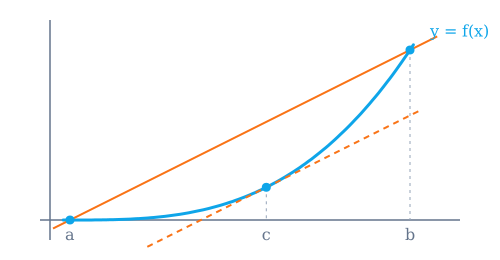
The tangent at is parallel to the secant through and .
## Statement
:::theorem[Mean value theorem]
Let $f$ be continuous on $[a, b]$ and differentiable on $(a, b)$.[^rudin]
Then there is a point $c \in (a, b)$ with
$$
f'(c) = \frac{f(b) - f(a)}{b - a}.
$$
:::
:::proof
The function $g(x) = f(x) - \frac{f(b) - f(a)}{b - a}(x - a)$ has
$g(a) = g(b) = f(a)$, so by Rolle's theorem $g'(c) = 0$ for some
$c \in (a, b)$, which is the claim.
:::
## Why it matters
The secant through the ends of the graph has a parallel tangent, as
[the figure](#fig-mean-value) shows.
::::figure{#fig-mean-value}

The tangent at $c$ is parallel to the secant through
$(a, f(a))$ and $(b, f(b))$.
::::
[^rudin]: W. Rudin, *Principles of Mathematical Analysis*, 3rd ed.,
McGraw-Hill, 1976, Theorem 5.10.When the note is ready, Create Publication under the form publishes it, with the visibility you choose beside the button. Add categories and tags first: they are how readers who do not know you find it. See Publications.
Footnotes
-
W. Rudin, Principles of Mathematical Analysis, 3rd ed., McGraw-Hill, 1976, Theorem 5.10. ↩